Media & Gallery
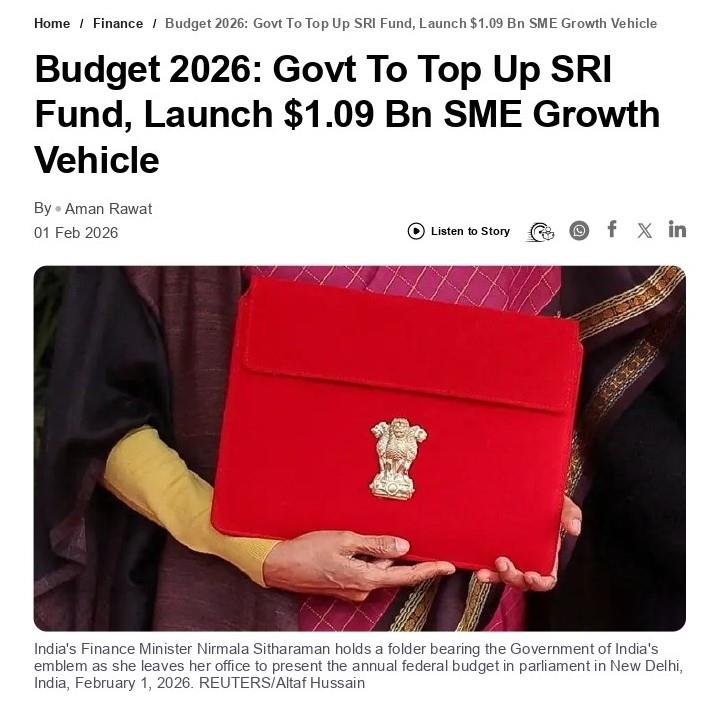
India's Finance Minister Nirmala Sitharaman holds a folder bearing the Government of India's emblem as she leaves her office to present the annual federal budget in parliament in New Delhi, India, February 1, 2026.
Presenting the Union Budget 2026-27 on Sunday, finance Minister Nirmala Sitharaman announced a slew of measures aimed at boosting economic growth, supporting micro, small and medium enterprises (MSMEs), and strengthening India's startup and innovation ecosystem.
As part of the proposals, Sitharaman said the government will top up the Self-Reliant India (SRI) Fund with an additional Rs 2,000 crore ($218 million). "I also propose to top up the Self-Reliant India Fund, set up in 2021, with Rs 2,000 crore to continue support to micro enterprises and maintain their access to risk capital," she said.
The SRI Fund is a government-backed equity investment initiative focused on providing growth capital to MSMEs with the potential to scale into larger businesses and contribute to economic growth. Launched in 2020-21 under the Atmanirbhar Bharat programme, it was created to address the funding gap faced by the MSME sector.
For Further reading please click on the link https://www.vccircle.com/budget2026-govt-to-top-up-sri-fund-launch-1-09-bn-sme-growth-vehicle
02-02-2026
" Snippets from Interview of Sh Ateesh Singh, Joint Secretary, Ministry of MSME, Govt. of India ,Govt. Nominee Director of NVCFL with Zee Business News on How to Grow Your Business? How to Tackle Financing Challenges? How Big a Challenge Are Delayed Payments? What’s the Math Behind the SMA Category? How Does TReDS Support MSMEs? Why Is Udyam Registration So Special? #MSME #SmallBusiness #BusinessGrowth #Entrepreneurship #Finance #CashFlow @ZeeSaurabh
For further information /viewing please go to this link
https://x.com/ZeeBusiness/status/2003793918664859699?s=20
26-12-2025
An Article is published in Economic Times on " Effective tax rate: The shadow metric of India’s growth story” by Sh Ateesh Singh, Joint Secretary, Ministry of MSME, Govt. of India ,Govt. Nominee Director of NVCFL.
India's tax landscape needs a re-evaluation of the Effective Tax Rate. This is a vital metric that impacts enterprises large and small, shaping investment opportunities, job creation and overall fiscal health. A convoluted tax framework often conceals hidden expenses, particularly burdening smaller firms.
India’s ongoing policy thought and expression on the “Effective Tax Rate” (ETR) reflects a form of groupthink about how corporate India is structured, how India taxes income (and where), and how policy choices trade off investment, jobs, compliance, and revenue. In India’s march towards Viksit Bharat, the conversation has been around sustaining economic growth, issues in fiscal and financial regimen, revamping ease of doing business and digitalizing interfaces.
For Further reading please go to this link https://m.economictimes.com/news/economy/policy/effective-tax-rate-the-shadow-metric-of-indias-growth-story/amp_articleshow/126160703.cms
26-12-2025
An Article is published in Financial Express on " India Inc's Journey of Conscience: From Moral Roots to Ethical Renaissance” by Sh Ateesh Singh, Joint Secretary, Ministry of MSME, Govt. of India ,Govt Nominee Director of NVCFL
While the government, regulators, policy makers and think tanks can provide the necessary frameworks and superstructures, the real onus for transformation would bear upon the business community at large. As India charts its journey toward the aspiration of becoming a developed nation by 2047, it must return to the moral promise embedded in its own history. When it was declared on the eve of Independence that India was making ‘a tryst with destiny,’ it was not merely a statement of political freedom but a call for invoking a deeper responsibility, a call to rediscover the “soul of a nation long suppressed”.Today, as we march ahead as the third largest and fastest growing major economy of the world, the call finds resolution with the potent sense of urgency. Economic expansion, technological leaps, and infrastructural ambition are essential, but they are not sufficient to fulfil this modern tryst with destiny. True development demands the inner strength of a society, its integrity, its ethical vision, its discipline, and its unwavering commitment to justice and fairness.The India of 2047 cannot simply be richer; it must be truer to the ideals of conscientiousness, correctness and candor. To rise fully, India must marry its economic aspirations with the moral clarity that once defined its civilizational identity. Only then can the promise made at midnight in 1947 find its complete and glorious expression a century later.
Accordingly it is not only imperative but also critical to bring “ethics in business” in the center of the conversation on economic development and transformational progress.
For Further reading please go to this link https://aspire.financialexpressb2b.com/blogs/india-incs-journey-of-conscience-from-moral-roots-to-ethical-renaissance
02-12-2025
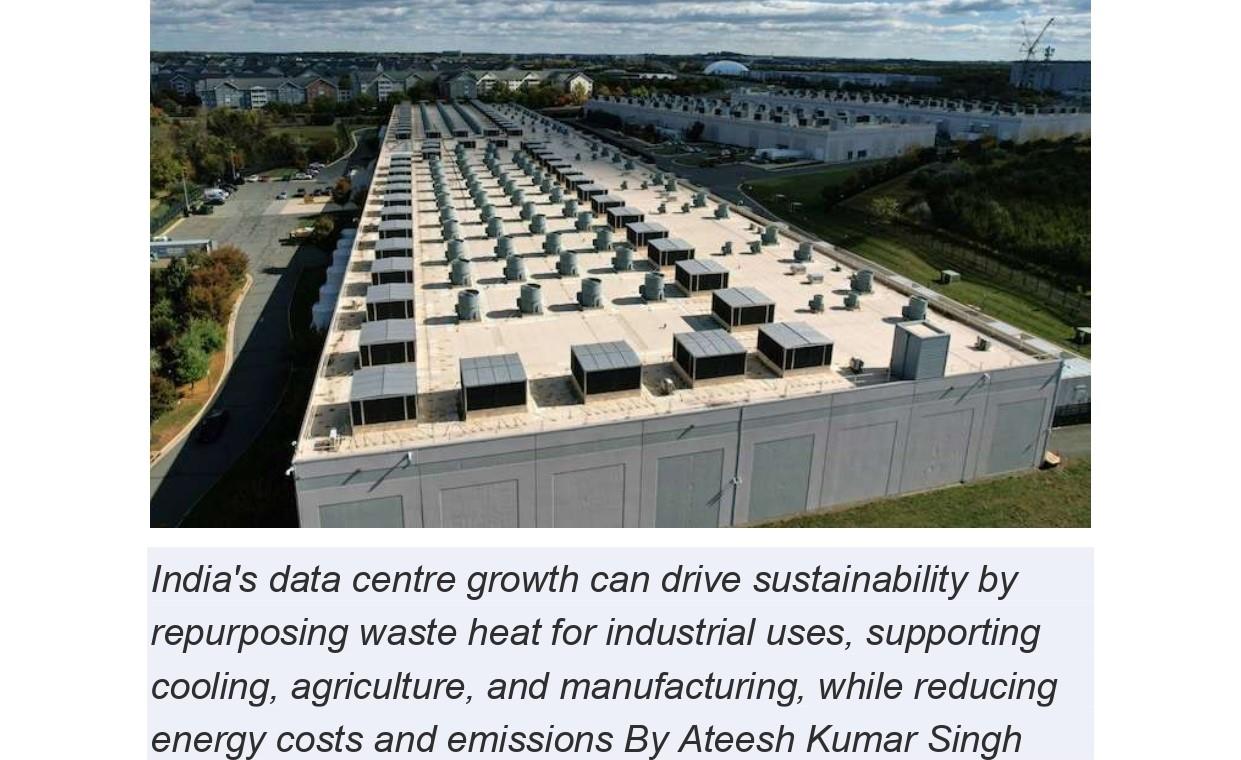
An Article is published in Money Control on " India's data centre growth can drive sustainability by repurposing waste heat for industrial uses, supporting cooling, agriculture, and manufacturing, while reducing energy costs and emissions by Sh Ateesh Singh, Joint Secretary, Ministry of MSME, Government of India ,Govt Nominee Director of NVCFL : India’s data centre sector is poised for a massive expansion, driven by the country’s growing digital needs. However, as data centres consume vast amounts of energy—nearly half of which goes into cooling the servers—sustainability must be at the forefront of this growth. One promising solution is repurposing the waste heat generated by these facilities. By capturing, redirecting, and monetizing this heat, India can blend growth with sustainability. For Further reading please go to this link https://www.moneycontrol.com/news/opinion/india-s-data-centre-boom-a-path-to-sustainable-growth-13700895.html
01-12-2025
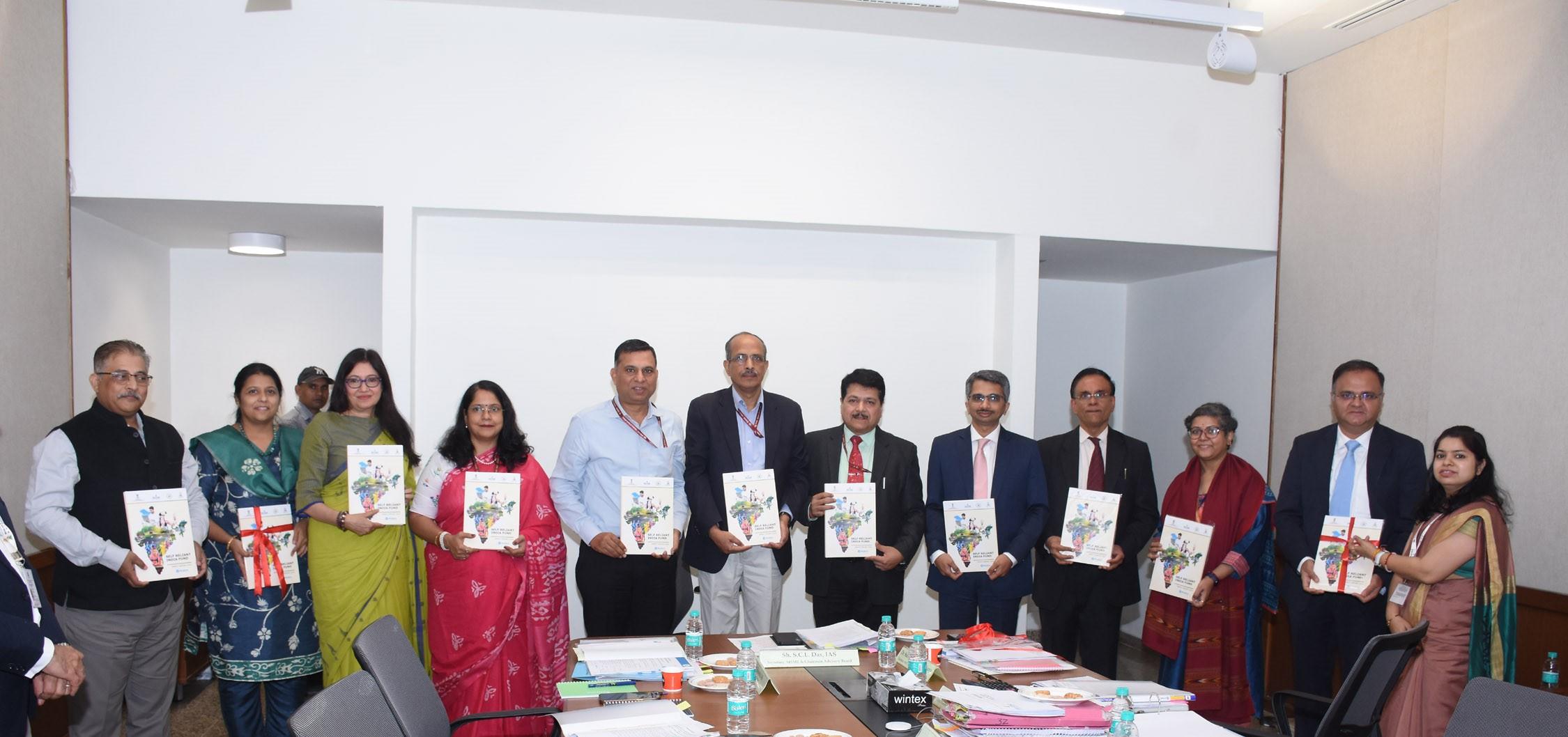
The Book on Impact Report (2024) of Self-Reliant India (SRI) Fund, the sovereign Fund of Funds of Ministry of MSME was unveiled by Shri. S.C.L.Das, IAS, Secretary Ministry of MSME alongwith Dr Rajneesh, IAS, Additional Secretary & Development Commissioner (AS & DC) , Dr. Subhransu Sekhar Acharya, Chairman (NVCFL) & CMD, NSIC Ltd, Ms Ashwini Lal, Add. Development Commissioner (ADC), Ministry of MSME & Government Nominee Director of NVCFL in the presence of other Board Members and participants during the 6th Advisory Board Meeting of SRI Fund held on 7th November2025 at Kartvaya Bhawan, New Delhi
20-11-2025
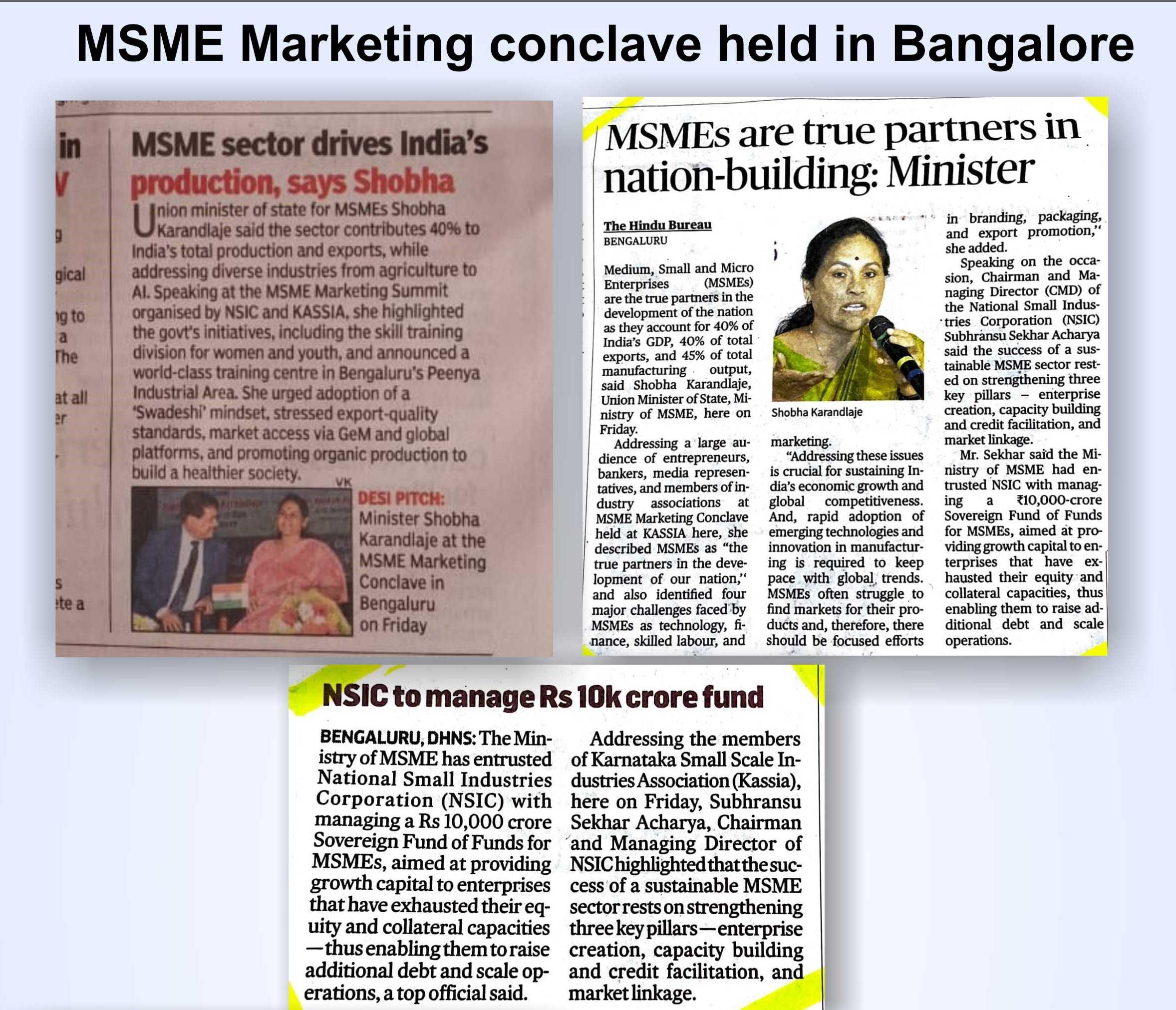
The MSME Marketing Conclave was organised by National Small Industries Corporation (NSIC) and NSIC Venture Cpital Fund Ltd(NVCFL) , under the Trade Enablement & Marketing (TEAM) initiative of Ministry of MSME on 10.10.2025 at the KASSIA Conference Hall, Bangalore. The Conclave was graced by Sushri Shobha Karandlaje, Hon’ble Minister of State, Ministry of MSME, as the Chief Guest and other dignitaries present included the Sh. Ateesh Kumar Singh, Joint Secretary-AFI, Ministry of MSME & Government Director in the NVCFL Board, Dr.Subhransu Sekhar Acharya, Chairman-cum-Managing Director, NSIC and Chairman , NVCFL and Sri Ninganna S. Biradar, Vice-President, Karnataka Small Scale Industries Corporation (KASSIA).
17-11-2025
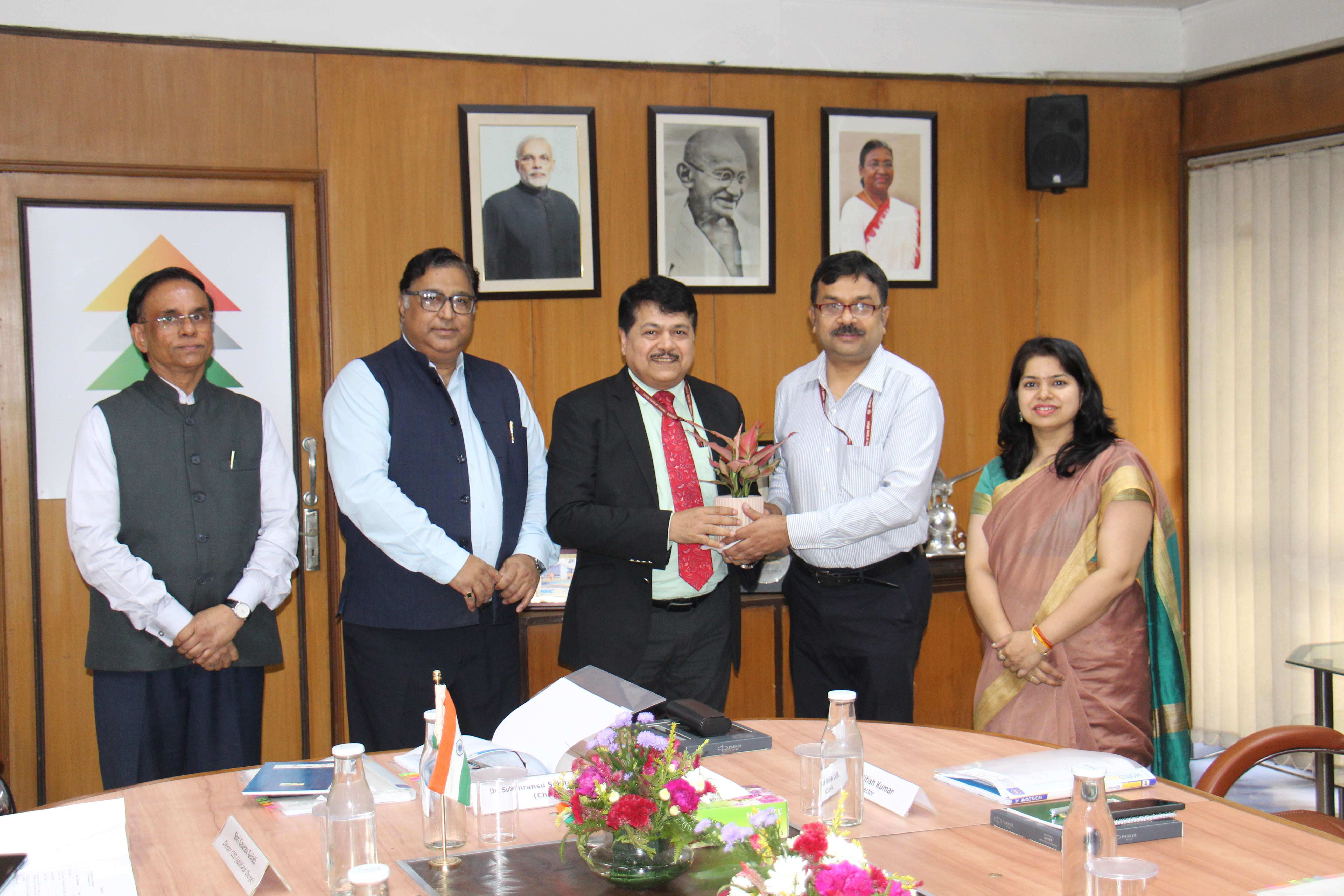
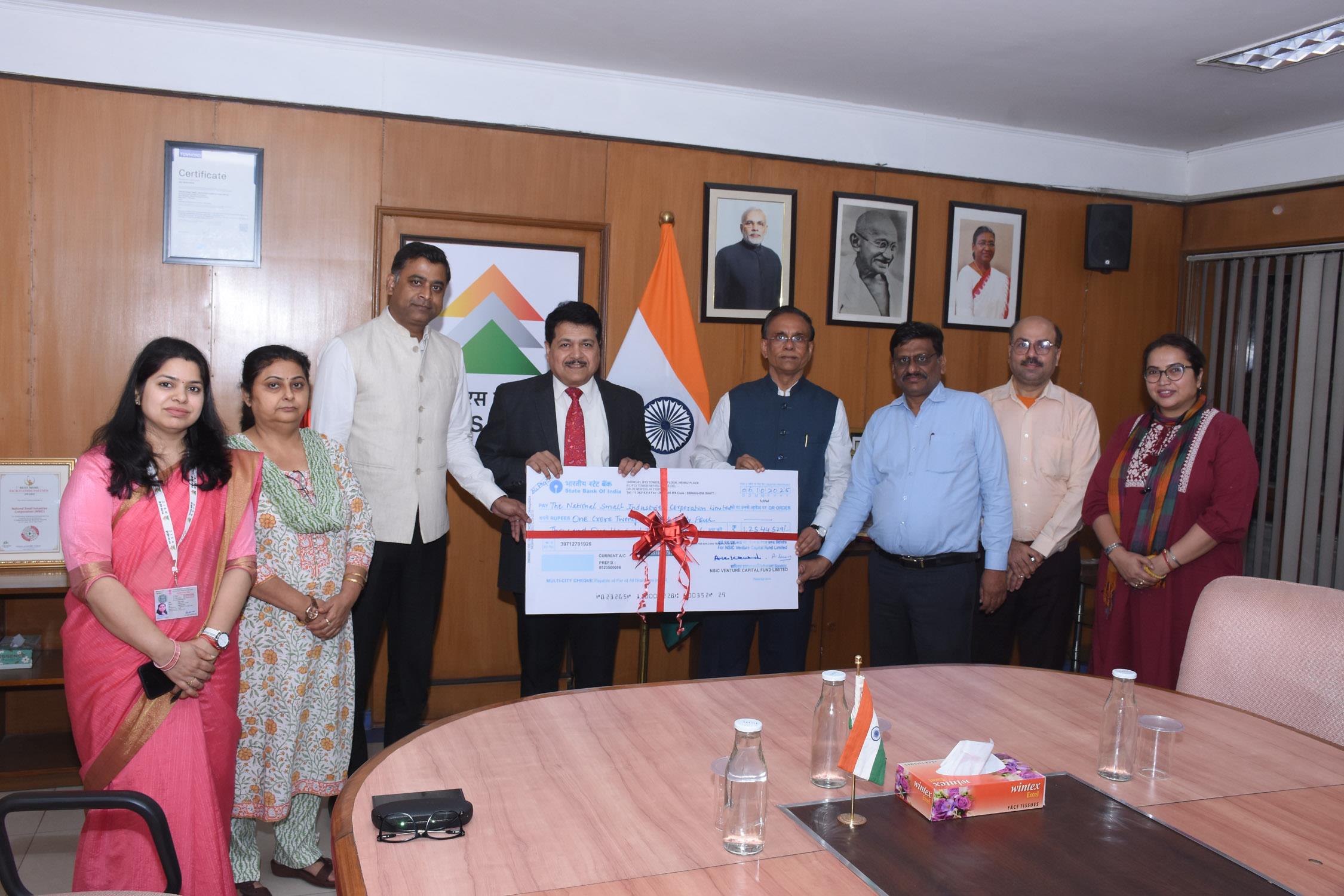
NVCFL paid a dividend of ₹1.25 crore to the NSIC Ltd for the financial year 2024-25. The dividend cheque was presented by Sh. Saravana Kumar, Director & CEO (NVCFL) to Dr. Subhransu Sekhar Acharya, CMD, NSIC Ltd & Chairman (NVCFL). Also present on the occasion were Shri Kartikeya Sinha, Director (P&M) and Ms. Nishtha Goyal , Company Secretary
30-10-2025
"Unlocking the Next Wave of MSME Growth" -An Article By Sh Saravana Kumar, Director & CEO of NSIC Venture Capital fund was published on September 20th, 2025 in Business world Magazine
14-10-2025
An Article is published in The Financial Express on " The Next Generation Reforms Required on TReDS to Boost MSME Financing in India" by Sh Ateesh Singh, Joint Secretary, Ministry of MSME, Government of India ,Govt Nominee Director of NVCFL : Under the Viksit Bharat goals, next generation reforms have been identified as a key pillar to drive economic growth and development. The TReDS regime needs to align itself with the growth trajectory by strongly participating in the next generation reform. For Further reading please go to this link https://aspire.financialexpress.com/blogs/the-next-generation-reforms-required-on-treds-to-boost-msme-financing-in-india
08-08-2025
An Article is published in Financial Express on Formalisation to financing: Understanding digital public infrastructure’s role in bridging MSME gaps by Dr. Ishita G. Tripathy, Former Govt Nominee Director, NVCFL Board and Former ADC of MoMSME.
The heightened role of Digital Public Infrastructure (DPI) has the potential to positively transform the MSME sector, underscoring accessibility and transparency, besides easing doing business. DPI is an important instrument in addressing information asymmetry and enabling MSME financing.The significance of the MSME sector in India is amply demonstrated by its contribution to gross value added, employment generation and exports. The heightened role of Digital Public Infrastructure (DPI) has the potential to positively transform the MSME sector, underscoring accessibility and transparency, besides easing doing business. DPI is an important instrument in addressing information asymmetry and enabling MSME financing.
(For Further Reading please go the link https://www.financialexpress.com/business/sme-formalisation-to-financing-understanding-digital-public-infrastructures-role-in-bridging-msme-gaps-3876863/)
12-06-2025
Tech-Jus: Enhancing Access to Justice through Online Dispute Resolution Article in ICAI Journal by Sh Ateesh Singh, Joint Secretary, Ministry of MSME, Government of India ,Govt Nominee Director of NVCFL :
The Indian judicial system is currently grappling with an extensive backlog of cases, which hinders the right of access to justice and significantly impacts economic growth and the ease of conducting business. As per the data available on the National Judicial Data Grid as on 20th May 2025, more than one crore civil cases are pending across the country. e Government of India enacted a central legislation, namely the Micro, Small and Medium Enterprises Development (MSMED) Act, 2006, to catapult the holistic growth of micro, small, and medium units and provide them with a competitive advantage. e MSMED Act provided a special framework for the resolution of delayed payment disputes faced by micro and small enterprises (MSEs) through alternative dispute resolution, including mandatory conciliation and statutory arbitration. It is pertinent to state that the legislature envisioned the adoption of the alternative dispute resolution methods through mandatory pre-arb conciliation and statutory arbitration in 2006, when such methods were not widely common or adopted.
For Further reading please click the link mentioned below
https://www.icai.org/post/icai-e-journal-main
.1530 Theme_Ateesh Singh
06-06-2025
Article on "Why India needs a homegrown AI model for its MSME sector" by NVCFL’s Government Nominee Director and Joint Secretary (AFI) of Ministry of MSME , Government of India Sh. Ateesh Kumar Singh Published in Financial Express (https://www.financialexpress.com/business/sme-why-india-needs-a-homegrown-ai-model-for-its-msme-sector-3858792/ )
30-05-2025
Rising North East -Investors Summit to be held on 23rd and 24th May'2025 at Bharat Mandapam, New Delhi-Inauguration by Sh Narendra Modi-Prime Minister
20-05-2025
Rising North East- Investors Summit 2025 to be held on 23rd and 24th May'2025 at Bharat Mandapam, New Delhi
20-05-2025
On April 9th, 2025, NSIC (The parent organization of NVCFL) exchanged MoU with SBA, Slovakia country for MSME Cooperation during State visit of Hon'ble President of India. NVCFL Chairman Dr Subranshu Sekhar Acharya has exchanged MoU with SBA, Slovakia in the presence of Hon'ble President of India, Smt.Droupadi Murmu.
11-04-2025
On April 9th, 2025, NSIC (The parent organization of NVCFL) exchanged MoU with SBA, Slovakia country for MSME Cooperation during State visit of Hon'ble President of India. NVCFL Chairman Dr Subranshu Sekhar Acharya has exchanged MoU with SBA, Slovakia in the presence of Hon'ble President of India, Smt.Droupadi Murmu.
11-04-2025
Karnataka sees highest MSME funding from SRI fund As a part of Atmanirbhar Bharat package, Rs 50,000 crore equity infusion for MSMEs through Fund of Funds was announced in 2020, for which the SRI Fund was set up.
Implementation of the government’s Self-Reliant India Fund (SRI Fund) over the past five years has remained limited in most states. Only a handful of MSMEs have benefitted under the fund in most states and UTs. However, Karnataka seems to have beaten the lag with 151 investee companies, the highest in India, according to a reply in Lok Sabha by the Minister of State for micro, small, and medium enterprises (MSMEs), Shobha Karandlaje, With very few states having reached double digits, only Maharashtra is a close second with 144 investee MSMEs. In total, 577 companies across India have benefitted from the fund since its inception, as of February 28, 2025. As a part of Atmanirbhar Bharat package, Rs 50,000 crore equity infusion for MSMEs through Fund of Funds was announced in 2020, for which the SRI Fund was set up. Under the fund, there is a provision of Rs 10,000 crore from the central government and Rs 40,000 crore comes from private equity and venture capital funds. The funding aims to help those MSMEs which have the potential and viability to grow and become large units, Karandlaje said. Under the operationalisation of this central sector fund, 60 daughter funds have been empanelled including Tata Capital, IDBI Capital, SIDBI Venture, ICICI Venture, amongst others. “By way of investing of Rs 10,979 crore, 577 MSMEs have been assisted... according to the written reply furnished. “Under SRI Fund, Rs 1,722 crore has been allocated and released by the central government to NSIC Venture Capital Fund Limited (NVCFL) and an amount of Rs 1,641.90 crore has been utilised,” added Karandlaje.
NSIC Venture Capital Fund Limited (NVCFL), a wholly-owned subsidiary of National Small Industries Corporation (NSIC), operates as the mother fund.
As per the model, the SRI Fund shall invest in SEBI registered Category I and Category II Alternative Investment Funds (the daughter funds), which shall in turn invest in MSMEs. The daughter funds shall invest at least five times the amount of capital. contribution received from SRI Fund (net of fees and expenses) in MSMEs, defined as per the MSMED Act.
(Published in Deccanherald , Bengaluru, 21 March 2025, 03:09 IST Karnataka News : https://www.deccanherald.com/india/karnataka/k-taka-sees-highest-msme-funding-from-sri-fund-3455567)
21-03-2025
NVCFL’s Government Nominee Director and Joint Secretary (AFI) of Ministry of MSME , Government of India Sh. Ateesh Kumar Singh delivers the Special Address at the FE Inclusive Finance Conclave held on 27th Februray’ 2025 at Eros Hotel, New Delhi highlighting the key initiatives and opportunities in the MSME sector as Financial Literacy amongst MSMEs is the key to their growth and success.
05-03-2025
NVCFL’s Government Nominee Director and Joint Secretary (AFI) of Ministry of MSME , Government of India Sh. Ateesh Kumar Singh’s Press Article on “Greening the MSMEs: Policy perspectives” is published in Financial Express, dated 19th Feb. 2025 : - MSME participation and engagement are fundamental as they contribute significantly to the economic process across sectors. However, participation and engagement are still insufficient, unfinished, undeveloped, and incohesive. The 2023 Global Sustainable Development Report (GSDR) finds that at this critical juncture, midway to 2030, incremental and fragmented change is insufficient to achieve the Sustainable Development Goals (SDGs) in the remaining 7 years. The report further goes on to say that implementation of the 2030 agenda requires a systematic and structured approach through deliberate and desirable transformations.
The Panchamrit targets and the Nationally Determined Contributions provide a systematic and structured approach at the macro level. MSME participation and engagement are fundamental as they contribute significantly to the economic process across sectors. However, participation and engagement are still insufficient, unfinished, undeveloped, and incohesive. The environmentalists are very fond of using the term “Hard to Abate” sector for those industries where the transition to lower emissions is not straightforward due to technology limitations or high costs. I would like to argue that the MSME is the “Hard to Debate” sector.
The MSMEs operate in the full spectrum of the industrial landscape – the high-end ones who understand sustainability and have adopted the green mantra in their business strategies and operations, and the ones at the bottom of the pyramid where their very survival and existence are at stake.
In the middle are the units that have acknowledged the criticality of the subject but have no wherewithal or support to get there. The ones at the bottom and the middle, which may be nano, micro, small, or medium, depending on their respective region and sector, are “Hard to Debate”. The central question, therefore, that needs to be answered by any strategy or policy is “What is in it for MSME?”. And, therein lies the crux of “Hard to Debate”. How does one argue with the MSME to get into the Green Arena?
The possible answers to the primordial question are social responsibility, mindfulness of the future, and conservation of resources. “A sustainable business strategy is not just a choice but a responsibility” is an oft-cited argument.
While that may be true the reality is different. The real answer lies in what sustainability brings to the MSME. In my view, the critical factors are profitability and growth. Profit is a function of cost and revenue. The cost of production can be reduced by bringing in operational efficiency and resource optimization. Revenue can be enhanced by deploying the 4 Ps (Product, Price, Positioning, and Promotion) of marketing among other things.
Further, since climate change is emerging as a new threat to business, it is important that resilience is built into the growth trajectory. Climate action calls for identifying climate-related risks that may arise from climate change or from efforts to mitigate climate change, their related impacts, and economic and financial consequences.
Any business strategy, policy prescription, or government support must necessarily build in elements that provide those levers into the transformation process.
The metamorphoses must intrinsically factor in three ground realities – enterprise lifecycle, sectoral diversity in manufacturing and services, and regional heterogeneity. The 4 stages in the development cycle of an enterprise, ideation and start-up, growth and expansion, maturity and renewal or exit, need customized solutions. Similarly, the distinct production process and service delivery models of 1,300 plus five-digit NIC codes sub-classes for MSMEs demand a blend of individual and mixed interventions. The aforementioned two realities must inevitably be read through the lens of regional variation and characteristics.
The government in its role as an enabler, facilitator, and provider bears the responsibility to develop the transition roadmap for MSME, through the instruments of policies, programmes, frameworks, regulations, institutions, and capacity building. Presently the ongoing effort towards greening and sustainability is disconnected, asymmetrical, and limited. While all this is good, for the “Hard to Debate”, good is not enough, its baseline. To make good great it is imperative to deploy the whole of government approach by synergizing with state governments, private corporations, non-profit organizations, academia, regulators, and international agencies.
The starting point could be to set up a strong institutional arrangement in the form of a hub and spoke model, with the Centre of Green Policy for MSME at the national level and branches at the state level. It would act as the central agency for conceptualizing, developing and implementing the transition roadmap for MSME by partnering with all stakeholders on a continuous basis.
The Centre of Green Policy for MSME will be a dedicated institute that will act as a hub for innovation, and capacity building of green practices and will equip MSME with knowledge, tools, and support for adopting sustainable solutions across sectors and regions in a bespoke mode.
Lack of scale at a unit level is a huge challenge for the MSME in adopting green transition. Any government strategy aimed at bringing in elements of sustainability into the MSME ecosystem must be cognizant of this hard reality. The key to breakthrough lies in harnessing the aggregation model. The introduction of green technologies, demonstrating their usefulness and replication at a large scale can only be attained through industry clusters and supply chains.
According to a report by NITI Aayog, five sectors (textiles, steel rerolling, foundry, food processing, and paper) cover approximately 60 per cent of total MSME emissions. The focus of the transition roadmap could be on the energy-intensive sectors so that the best effort to impact is attained.
The effort to incentivize could come from programmatic action on both the demand and supply side through financial and non-financial benefits. The former would include working with instruments of capital subsidy, interest subvention, credit enhancements, tax relief, and accelerated depreciation. The latter, on the other hand, would entail the provisioning of energy-efficient technology, infrastructure, labelling, marking, certification, business reporting and disclosures, diagnostic studies, green premium, handholding, training, capacity building, and awareness.
In all the push towards the green agenda, various programmes and frameworks have been developed. On account of the non-availability of a singular recognized definition of “Green” or “Sustainability,” Greenwashing is fast becoming a big stumbling block in making good great. Clear and unambiguous definitions are urgently required in the green taxonomy for financing and marketing.
The Ministry of MSME has launched several initiatives such as Zero Defect Zero Effect (ZED), Green Investment and Financing for Transformation (GIFT), and Scheme for Promotion and Investment in Circular Economy (SPICE) to promote the adoption of green and sustainable practices.
Yet hindrances such as limited financial access, technological gaps, and regulatory and compliance burdens persist. Looking ahead, MSMEs must also prepare for upcoming obstacles such as EPR compliance, CBAM, and ESG regime. Beyond these visible challenges, a key intangible challenge lies within the core of the MSME sector, which has traditionally prioritized cost-cutting and output over sustainability, often perceiving green initiatives as expensive and complex.
The key to winning this “Hard to Debate” argument is to create a holistic strategy to expedite the transition with an aim to accelerate the momentum for green growth in the country by strengthening and synchronizing the existing programmes and fostering new-age reforms along with finding solutions to current challenges.
25-02-2025
Govt’s Rs 50,000 crore SRI Fund: Nearly Rs 2,000 crore invested in this many MSMEs in over 4 years. The scheme, which aims to offer growth capital to MSMEs, has a provision of Rs 10,000 crore from the central government and Rs 40,000 crore through private equity and venture capital funds. The Rs 50,000 crore Self Reliant India (SRI) Fund for equity infusion into MSMEs, launched in May 2020, has invested Rs 9,612 crore in 523 MSMEs as of November 30, 2024. In the current financial year, 91 MSMEs were supported with Rs 1,964 crore, Parliament was informed on Thursday. The year-on-year investment in MSMEs through the SRI fund grew to Rs 3,306 crore in 107 enterprises in FY24 from Rs 3,007 crore in 250 enterprises in FY23, and Rs 1,335 crore in 75 units in FY22, according to the data shared by Shobha Karandlaje, Minister of State in the MSME Ministry in a written reply to a question in the Lok Sabha. The scheme, which aims to offer growth capital to MSMEs, has a provision of Rs 10,000 crore from the central government and Rs 40,000 crore through private equity and venture capital funds. Operating on a mother-fund and daughter-fund structure for equity or quasi-equity investment in MSMEs, the SRI fund has 53 daughter funds empanelled including Tata Capital, IDBI Capital, SIDBI Venture, ICICI Venture, Indian Angel Network, Antler, and more
NSIC Venture Capital Fund Limited (NVCFL), which is a wholly-owned subsidiary of National Small Industries Corporation (NSIC) and a Category-II Alternative Investment Fund (AIF) with SEBI, operates as the mother fund. The daughter funds investing in MSMEs are required to invest at least 5x the amount of capital contribution received from the SRI Fund. However, seven companies so far have closed its operation after investment from the Self Reliant India fund viz., Kid Aptivity Technologies, Quality Tutorials, Signalx, Vc Agritech, Curiosity Edtech, GFM Retail, and Mooofarm, according to the details shared by Karandlaje in her response. (Courtesy : News of Financial Express published on 13th December;2024)
20-12-2024
Shri Saravana Kumar A., Director & CEO (NVCFL) presented dividend cheque for the year 2023-24 to Dr. Subhransu Sekhar Acharya, CMD (NSIC), Shri Kartikeya Sinha, Director(P&M), Shri Gaurav Gulati, Director(Fin), NSIC wherein Independent Directors on the NSIC Board and Company Secretary were also present.
18-12-2024
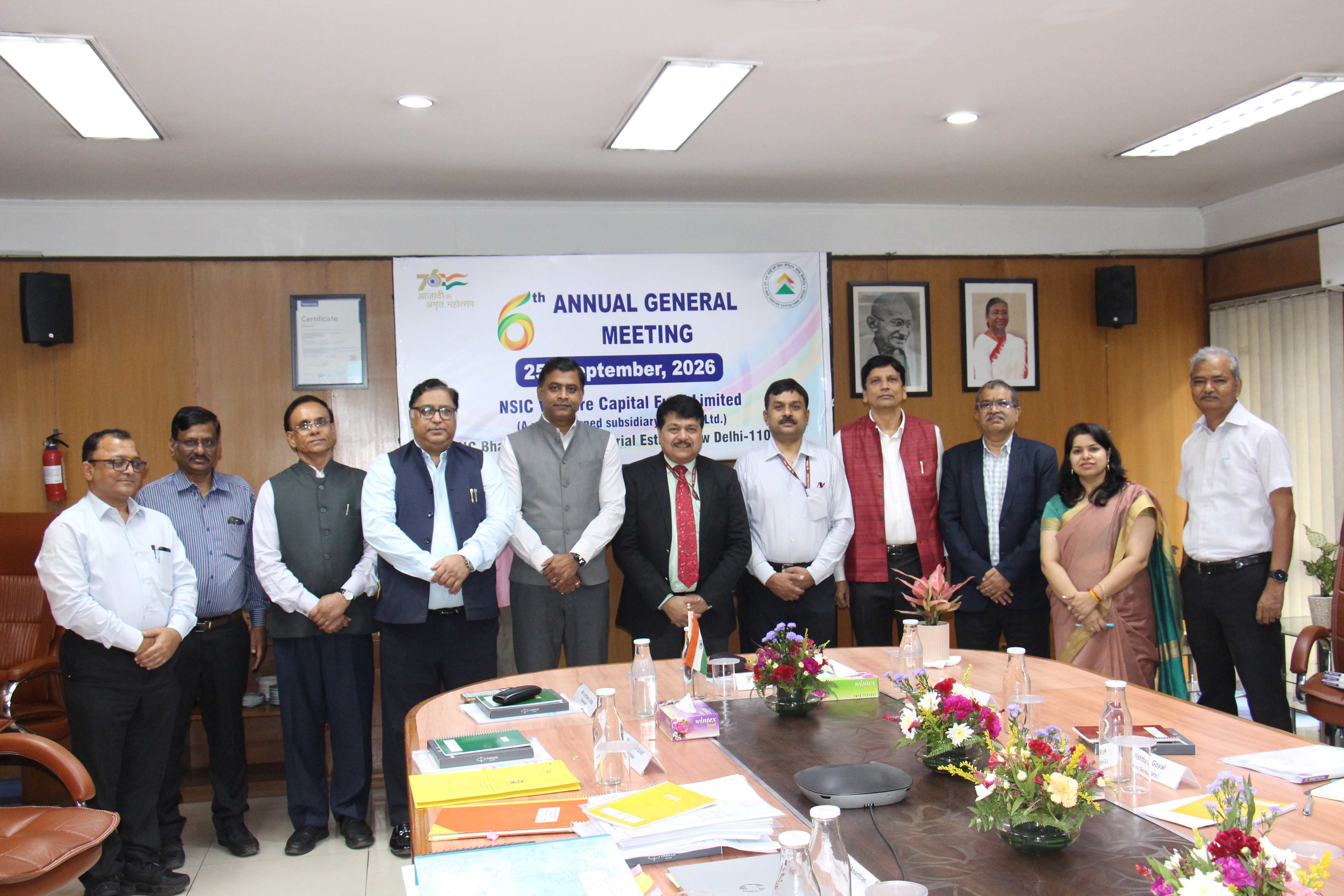
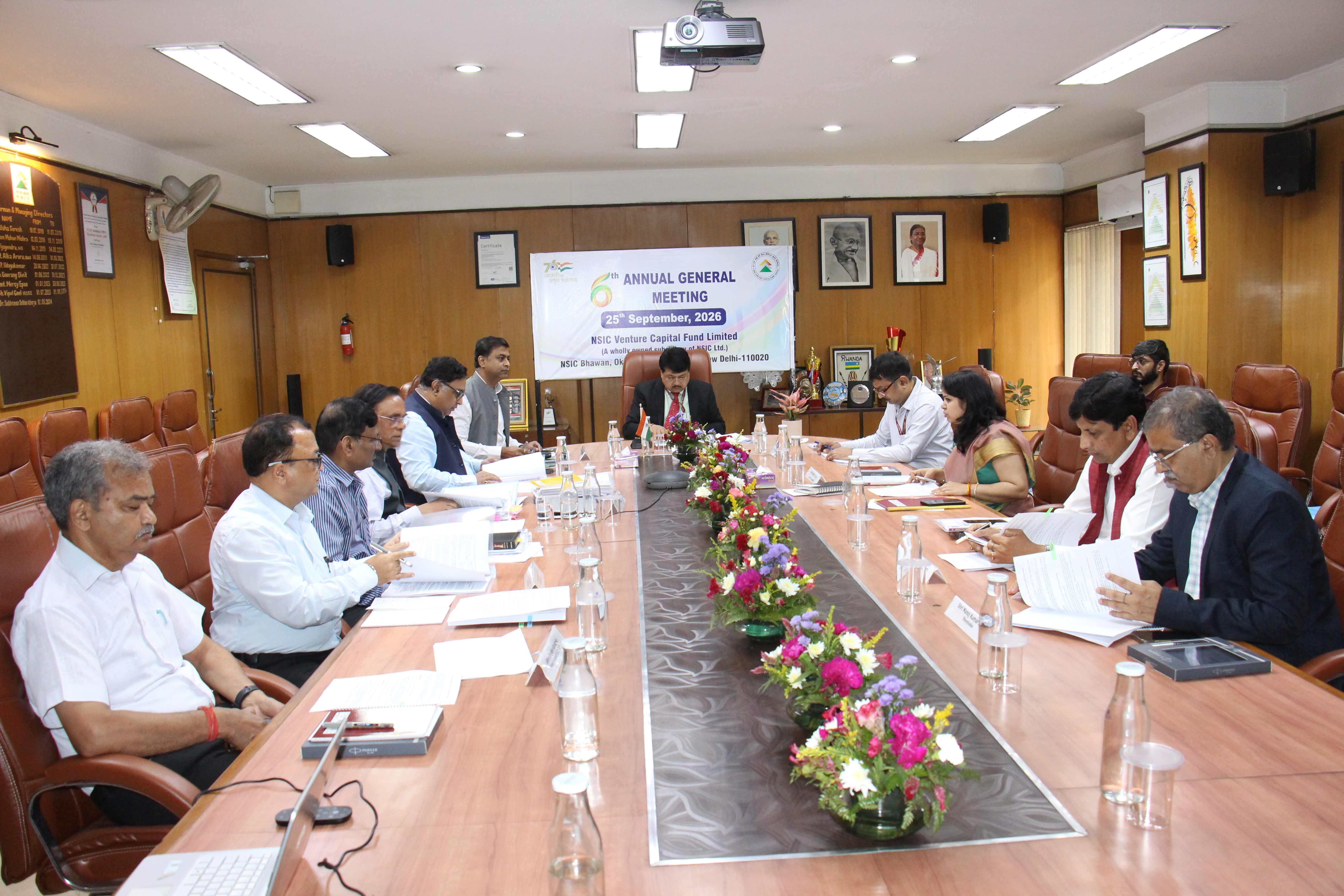
Dr. Subhransu Sekhar Acharya, Chairman NVCFL chaired the 4th Annual General Meeting of NVCFL held on 27th September, 2024 alongwith Shareholders, Statutory Auditors and other senior officials of the company wherein the annual accounts for the FY 2023-24 were adopted.
04-10-2024
In a significant strides towards fostering skill development and entrepreneurship, the Hon’ble Minister of MSME-Govt. of India, Shri. Jitan Ram Manjhi, and the Hon’ble Minister of state – Govt.of India Sushri Shobha Karandlaje inaugurated the new training program at the NSIC Technical Service Centre (NTSC) in Okhla, New Delhi. The event witnessed the presence of Shri S.C.L Das, Secretary MoMSME, Smt. Mercy Epao, Joint Secretary MoMSME, Ms. Simmi Choudhary (Economic Advisor and Joint Secretary MoMSME), Dr. S.S. Acharya, CMD-NSIC, Shri Kartikeya Sinha, Director (P&M) NSIC, Shri.Gaurav Gulati, Director (Finance- NSIC) and Shri. Saravana Kumar, Director & CEO (NVCFL)."
29-07-2024
CII Monthly MSME Diary , May 2024
05-06-2024
CII Monthly MSME Diary , May 2024
05-06-2024
CII Monthly MSME Diary , May 2024
05-06-2024
CII Monthly MSME Diary , May 2024
05-06-2024
CII Monthly MSME Diary , May 2024
05-06-2024
CII Monthly MSME Diary , May 2024
05-06-2024
Dr. Subhransu Sekhar Acharya, Chairman, NVCFL being welcomed by the Board of Directors on 20th May, 2024
20-05-2024
Dr. Subhransu Sekhar Acharya, Chairman, NVCFL being welcomed by the Board of Directors on 20th May, 2024
20-05-2024
Dr. Subhransu Sekhar Acharya, Chairman of NVCFL being welcomed by Sh Saravana Kumar, Director & CEO of NVCFL and his team on 04th May, 2024
08-05-2024
Sh. Saravana Kumar, Director & CEO (NVCFL) presented dividend cheque for the year 2022-23 to Shri Vipul Goel, CMD, NSIC. Also present on the occasion were Shri Kartikeya Sinha, Director (P&M) & Shri Gaurav Gulati, Director(Fin), NSIC.
07-02-2024
Sh. Vipul Goel being welcomed by the Board of Directors (NVCFL) on 28th August, 2023
29-08-2023
Ms. Mercy Epao being welcomed by the Board of Directors (NVCFL) in its meeting 13th Board meeting held on 17th January ,2023
23-01-2023
Shri P. UdayKumar and Dr .Ishita Ganguli Tripathy being welcomed by the Board of Directors (NVCFL) in its 9th Board meeting held on 8th July ,2022.
18-07-2022
Photographs taken on the occassion of signing of Contribution Agreement of SRI Fund on the 12th October, 2021 in the presence of the Hon'ble Minister for MSME, Shri Narayan T. Rane, Hon'ble MoS for MSME Shri Bhanu Pratap Singh Verma, Secretary MSME, Shri B.B. Swain, Chairperson NVCFL, Ms. Alka Arora
12-10-2021
NVCFL Board welcomes Ms. Alka Arora on her assuming charge as Chairperson, NVCFL
07-10-2021
In the gracious presence of Shri B.B. Swain, Secretary, MSME, Government of India, first copy of the PPM of SRI Fund, the first scheme of NVCFL being handed over to Ms. Ishita G. Tripathi, Additional Development Commissioner (MSME) by Ms. Alka Arora, CMD NSIC & Chairperson NVCFL. Also present are Shri Gaurang Dixit, Director, NVCFL and Shri K.M. Trivedi, Senior Advisor
07-10-2021
PPM of SRI Fund, the first scheme of NVCFL being handed over to Ms. Alka Arora, CMD, NSIC (Sponsors) by Shri Gaurang Dixit, Director, NVCFL
07-10-2021
NVCFL 1st Board Meeting Photographs.
15-09-2021